

- High Conversion & Low Bounce Rates
- Customer Acquisition Cost
- Customer Retention Rate
- Customer Lifetime Value
- Average Order Value
- Add - to - Cart Rate
- Cart Abandonment Rate
The conversion rate in eCommerce refers to the percentage of website visitors who purchase and become customers. Naturally, a high conversion rate is the goal of any online business. Average conversion rates differ by industry and channel (email, search, social), but they appear to be about 3% in general.
The percentage of website visitors who visit a page quickly and then leave is the bounce rate. Almost all eCommerce websites success depends on users engaging with page content, browsing different products, and making a purchase. As a result, a high bounce rate is unfavourable.
Businesses must invest in an engaging, high-quality eCommerce website that gives individualized value to visitors from the time they arrive on the landing page to enhance conversion rates and lower bounce rates.

There is no commerce — online or offline — without customers. Customer acquisition cost is the amount of money it takes to convert a customer. It's simple to calculate: divide a period's total marketing expenses by the number of clients obtained during that same period. For eCommerce organizations to grasp the actual value provided by their marketing activities, this is a critical measure. Naturally, most organizations will strive to keep customer acquisition costs as low as possible.
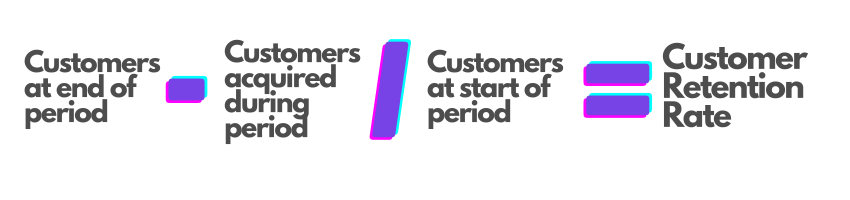
Getting new consumers is expensive, therefore having a steady supply of recurring clients is critical for most eCommerce businesses. Customer retention rate – the number of clients a brand has kept over time — is a straightforward calculation. Subtract the number of new customers acquired during a period from the total number of customers after the period, then divide the result by the total number of customers at the beginning of the period. Almost every business would benefit from a high retention rate.


We're all just numbers in the eyes of eCommerce marketing statistics. Client lifetime value (CLV) is a number that estimates how much total money a particular customer will bring into a company. It's tricky to figure out: first, remove the average order frequency rate from the average order value to get the customer value. The average customer longevity is then multiplied by the customer value. Customer lifetime value is the result, and organizations should strive to be as high as feasible.
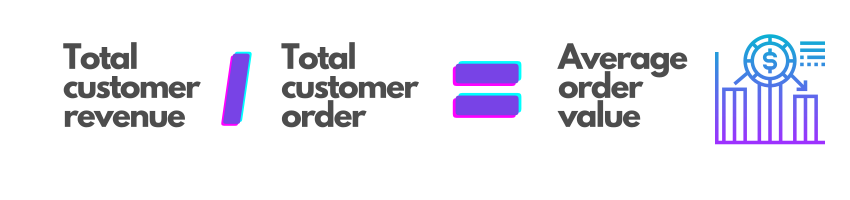
The average order value provides organizations with a quick estimate of how much a given consumer spends on average. It's simple to calculate: revenue generated by a customer is divided by the number of orders they've placed. Businesses can more properly market to clients with the highest value potential by knowing average order values.
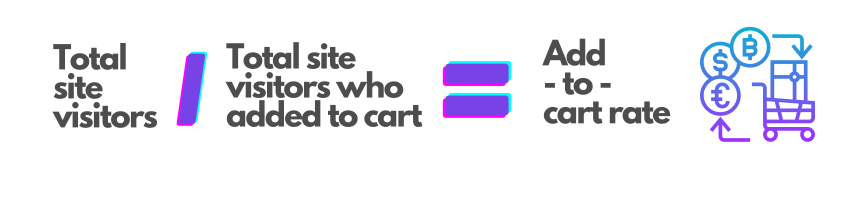
Purchase metrics aren't the only eCommerce data that can provide organizations with information about their customers' purchasing patterns. Adding an item to a digital shopping cart does not guarantee that the customer will buy it. The percentage of visitors who add something to their shopping baskets is tracked by the add-to-cart rate, whether customers purchase the product or not. The formula for calculating the add-to-cart rate is straightforward: total site visitors divided by total shoppers who added items to their cart. Add-to-cart conversion rate – total converted customers divided by total consumers who added to the basket — is similar. These indicators can assist firms in learning more about eCommerce consumer journeys and identifying potential checkout snags.

Shoppers frequently fail to complete their purchases for a variety of reasons. We've all been that shopper; it happens to the best of us. The cart abandonment rate indicates how many potential customers either forgot or purposefully abandoned their shopping carts. It's simple to calculate: divide the total number of completed transactions by the number of carts opened and added. Understanding cart abandonment rates can aid organizations in identifying eCommerce usability issues and developing more simplified solutions for customers.
"Instead of constructing isolated solutions for particular building blocks, companies should create an interconnected digital environment."

Website optimization and the direction of your overall business plan are both aided by eCommerce data. After you've decided what you want to track, the following step is to figure out how to do so with high confidence. With such information, you may run tests to see what changes you can make to improve your eCommerce revenue.